
Descript and Claude: Edit Video by Talking to an Agent
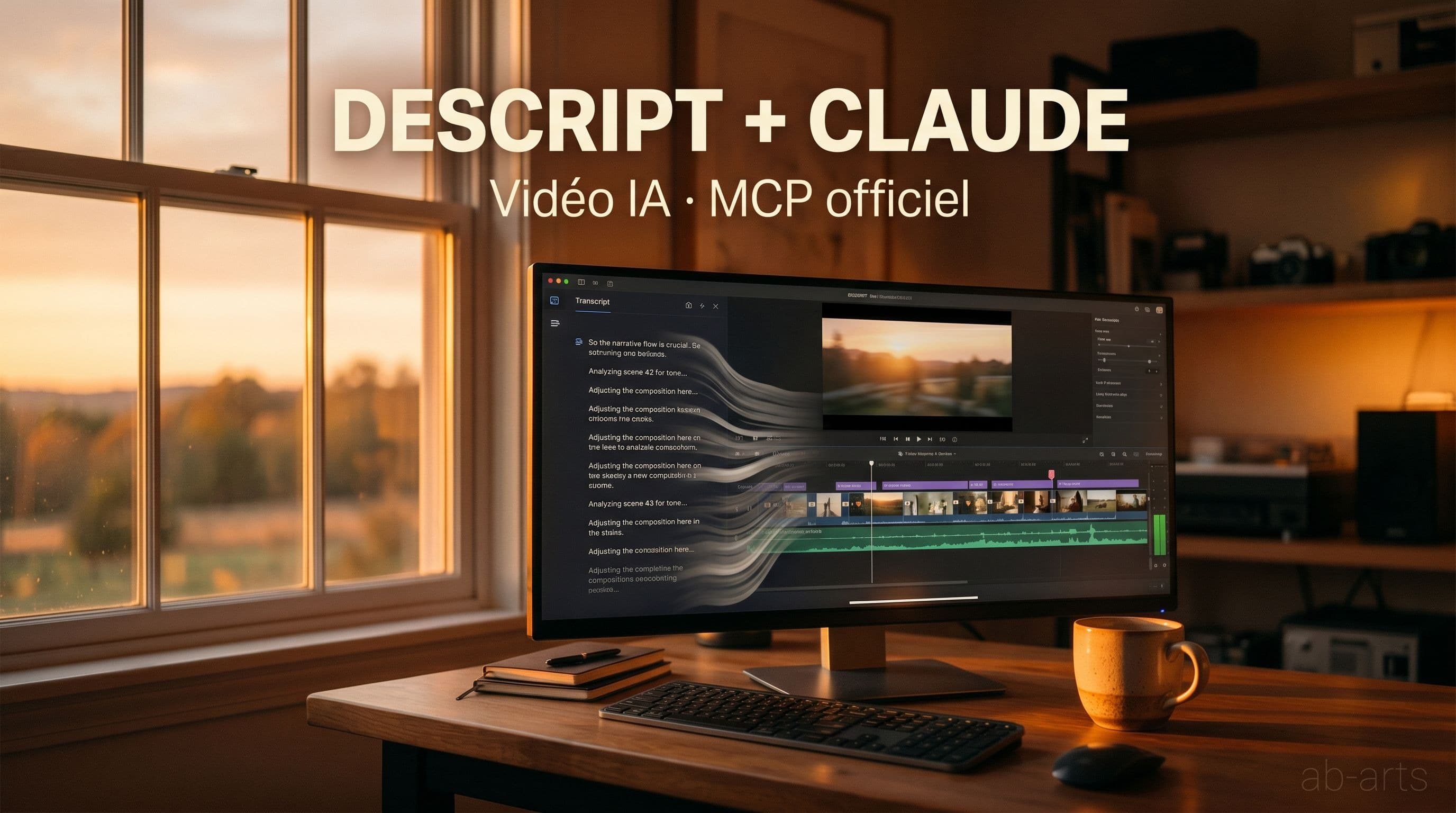
Classic video editing is patient and fragmented work. You scrub the timeline, hunt for a word said two minutes earlier, cut a hesitation, nudge a transition, start over. Half a day for a one-hour podcast, several days for something more ambitious. Descript already disrupted that routine years ago by transcribing the audio and letting the editor work the transcript like a document: delete a word in the text, and the corresponding clip is gone from the video. Now Descript moves one step further. The editor ships an official MCP server, and a Claude agent can drive the edit directly, by voice or written instruction.
In practice, you no longer sit in front of the timeline to find the moment a guest stumbled. You tell Claude, which locates the spoken phrase, cuts, reorders, and renders the segment. The timeline stays available for fine retouches, but the bulk of the work shifts to instruction. This is a new nature of editing, and it deserves a close look.
How Descript treats video as a document
Descript is an audio and video editor in which the transcript is the primary interface. You import a rush, the tool transcribes the track with accuracy that holds up on clear voices, and the transcript appears next to the video. From there, you edit the transcript: delete a paragraph, move another one, cut repetitions. Every text edit is reflected on the video. This is transcript-driven editing — driven by the text rather than the timeline.
Several features flow naturally from that model. Automatic detection of hesitations ("uhm", "like", long silences) suggests one-click cuts. Subtitle generation requires only a proofread, since the text is already there. Sentence rewriting goes through Overdub, a voice-cloning function that resynthesizes a few words in the original speaker's voice, provided the speaker has consented to training in advance.
For anyone producing video content on a regular basis — podcasters, trainers, comms teams, agencies — the benefit is immediate. You save on time spent searching the rush, on editorial fluidity, and on subtitle delivery. That said, Descript isn't here to replace Premiere or DaVinci on a fiction film: its turf is the spoken format, where editorial flow matters more than visual staging.
The official MCP server, or why Claude walks into the room
The 2026 news isn't about Descript alone. It's about the connection between Descript and Claude through the Model Context Protocol, an open standard describing how an LLM agent can discover and call the tools of a third-party application. Descript published its own official MCP server, and the official documentation to connect Descript to Claude walks through the few minutes needed to wire one to the other.
To place this in a wider movement, we've already covered the directory of official MCPs installable in a few commands and MCP tunnels that secure agent access to a private network. Descript fits squarely into that logic: expose its capabilities to an external agent, without rebuilding a custom client.
Once the connection is set, Claude sees Descript as a set of named tools. It can locate a moment by spoken phrase, delete a range of transcript, reorder segments, generate or tweak subtitles, export to a precise format. The user no longer runs a frozen macro: they write or dictate an intent, and Claude orchestrates the sequence of actions on the open project.
💡 The text is no longer just the transcript of the video. It becomes the timeline. Cutting, moving, restoring a segment is now an instruction in writing or speech, that the agent translates into concrete operations on the Descript project.
A real case: cleaning a one-hour podcast in minutes
Let's take a representative case. You just recorded a one-hour podcast with a guest. The raw rush carries the usual hesitations, two digressions to cut, a question repeated because the first phrasing didn't land, and a sentence to move ten minutes earlier because it introduces the following point better.
With Descript alone, you open the transcript, chase the "uhms" with the detector, cut the digressions by hand, identify the sentence to move by scrolling the text, grab it, drop it elsewhere, reread. Count forty minutes for an experienced operator.
With Descript + Claude through MCP, the sequence becomes:
- "Remove all hesitations and silences longer than one second."
- "Find the passage where the guest talks about the funding round, around the fifteen-to-twenty-minute mark, and move it right after the intro."
- "Cut the digression about holidays, it starts with 'speaking of summer'."
- "Generate the subtitles in English, keep them on two lines max, export to .srt."
Each instruction resolves in seconds on the agent's side. The timeline reflects the changes live, you reread the result, you retouch by hand where the agent went too far. The work drops to ten minutes, and the operator spends the bulk of their time arbitrating rather than scrubbing.
Three ways to cut, three savings
To measure what the agent really changes, here is a four-dimension comparison of the craft.
| Dimension | Classic timeline | Transcript-driven (Descript alone) | Agent-orchestrated (Descript + Claude MCP) |
|---|---|---|---|
| Locate a precise moment | Manual scrubbing, audio markers | Full-text search in the transcript | Phrase or intent dictated to the agent |
| Remove hesitations | Manual cuts, one by one | Automatic detector, batch validation | Single instruction, executed across the whole rush |
| Reorder segments | Drag and drop on the timeline | Copy-paste in the transcript | Semantic instruction ("move the X passage after the intro") |
| Multilingual subtitles | Manual typing or third-party plugin | Generation from the transcript | Generation, formatting and export driven by the agent |
The gap between the last two columns isn't a pure speed story. It's the very nature of the gesture that shifts. In the middle column, the editor still operates every action; they simply have a better interface. In the right column, the editor formulates an intent and arbitrates the result. The execution work is delegated.
Limits to keep in mind before getting too excited
This shift isn't magic, and three limits deserve to be stated clearly.
The first is transcription quality. On clear studio voices, the error rate stays very low. On noisy field recordings, strong accents, or poor sound, the transcript degrades and the agent inherits that imprecision. Best practice: verify the transcript on the first chapters before running an ambitious instruction chain.
The second is scope. Descript remains a spoken-content editor. For a cinema cut where visual staging trumps verbatim, the transcript-driven angle loses relevance. You go back to Premiere, DaVinci Resolve, or another image-centric editor.
The third is control. The more the agent takes over, the more critical the proofread becomes. An aggressive cut of hesitations can take away a breath that mattered to the rhythm. A segment move can break a callback referenced earlier. The rule we adopt at AB-Arts is simple: let the agent run the heavy passes, and always reread the full cut before export.
Who this workflow is immediately useful for
This new pairing is particularly valuable for four profiles. Podcasters get a clear acceleration on weekly editing. Trainers and speakers save on producing pedagogical capsules cut from a long take. Corporate comms teams shorten the gap between a raw interview and a publishable video. Video agencies, finally, can industrialize part of the dailies work while keeping editors on editorial value.
At AB-Arts, this type of chain interests us because it naturally extends our workflow and automation practice: drop a Claude agent at the right point in an existing pipeline, without reinventing the production tool. And driving an agent that orchestrates Descript is exactly what we work on in our Claude masterclasses, well beyond the single prompt.
For the reader who wants to test it for themselves, the path is two steps. First, read the official documentation to connect Descript to Claude and wire them up. Second, pick a rush you already edited by hand, and redo the same edit by dictating to the agent: the comparison is worth more than any speech.
→ To integrate this kind of orchestration into your own pipeline, write to us from the contact page. To learn how to drive a Claude agent up to this level of mastery, browse our masterclasses.
Move from reading to producing.
What we experiment with here, we ship for you. AB-Arts designs, trains and supports: three ways of working together, one team under the same roof.
Web, motion, video, image and campaigns. From concept to master, full production under one roof.
AB-Academy trains your teams in AI, workflows and creative tools. On-site or remote.
Audit, consulting, automation. We clear up your digital environment, and build what's missing.
Related articles
← All news
AB-Arts is a Google Partner: Cloud, Vertex AI, Workspace
AB-Arts is a Google Partner. We deploy Google Cloud, Vertex AI and Workspace for European teams: security, compliance and hands-on support.
Claude MCP Catalogue 2026: 131 connectors ready to wire
The full catalogue of official Claude MCPs sorted by business use, with the install command ready to copy. 131 connectors and counting.
Before automating, be curious: the AB-Arts method
Before writing an agent or wiring an MCP, you need to be curious, document what you know, and keep it current. The AB-Arts method for Claude.