
AB-Arts is a Google Partner: Cloud, Vertex AI, Workspace
AB-Arts is a Google Partner. In practice, that means our studio can deploy, configure and operate the full range of Google services for its clients: Google Cloud for infrastructure, Vertex AI for AI workflows, and Google Workspace for collaboration. The status, already visible in Anthony Beth's signature and in our Google AI Studio & Cloud masterclass, now opens a wider door: we own the project end to end, from scoping to production rollout.
In Europe, having a single point of contact changes the nature of a cloud rollout. Until now, a team had to juggle the Google sales rep, the technical integrator, the Workspace reseller and the security team to align three budgets and two roadmaps. From now on, AB-Arts takes that pivot role. We talk to Google on your behalf, we scope the services that make sense for your business, and we train your teams to use them. One conversation, one quote, one accountable partner.
This announcement lands at a specific moment. The maturity of Vertex AI, the embedding of Gemini across Workspace and the wider European datacenter footprint have brought together three worlds that used to stay separate: infrastructure, artificial intelligence and daily collaboration. For a Belgian or French organization, the time is right for a serious scoping exercise.
Google Cloud: the infrastructure backbone
Google Cloud is the compute, storage and data-processing infrastructure that the AI and collaboration services run on. The stack is mature: Compute Engine for virtual machines, Google Kubernetes Engine for managed Kubernetes, Cloud Run for serverless containers, and BigQuery for petabyte-scale analytical warehouses.
The Google network is also one of the fastest on the market: more than twenty European zones, including Saint-Ghislain in Belgium, and a private backbone that bypasses the public internet to move data between datacenters. For Belgian and French organizations that require their processing to stay in Europe, this local topology is not a sales detail. It is a regulatory prerequisite.
The engagements we take on fall into four families: migrating from legacy hosting to a native Google stack, building a data platform around BigQuery, deploying containerized applications on Cloud Run or GKE, and setting up elastic compute for heavy workloads. Each one only uses a subset of the catalog, never the full thing. The initial scoping is precisely about drawing that subset with care.
Vertex AI: enterprise AI without glue code
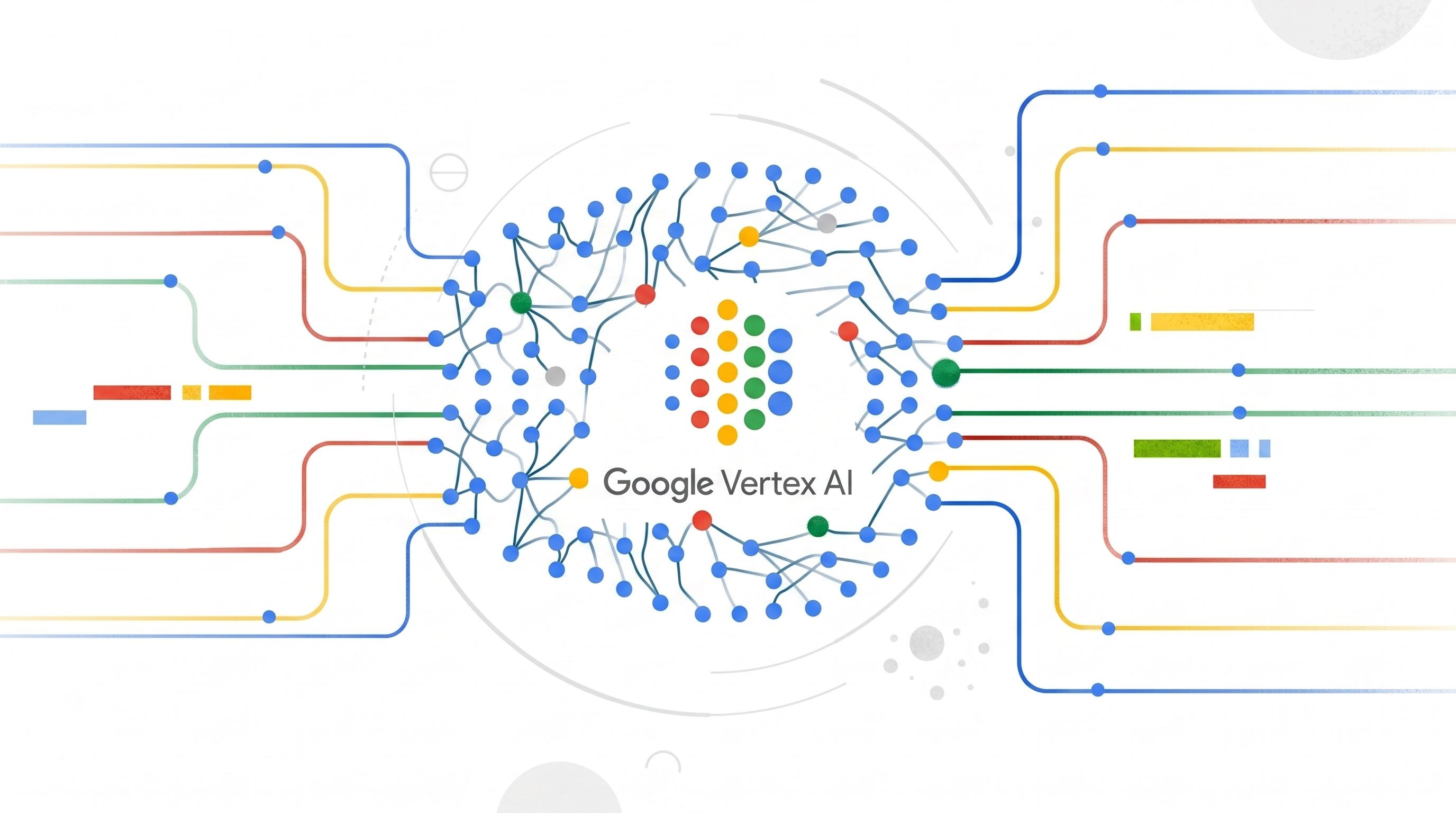
Vertex AI is Google's unified platform for AI models. It is where you consume the Gemini models, where you train your own, where you deploy agents, and where you wire all of that into your internal databases. Gemini, the flagship model, is multimodal: text, image, audio, video and code in a single call.
What used to require duct tape between three or four providers now fits inside one console. A RAG pipeline, meaning a system that grounds its answers in your internal documents, can be stood up in a few hours: Vertex AI Search indexes the source, Gemini formulates the answer, Cloud Logging records every call for audit. That said, the real value is not only technical.
💡 Vertex AI closes a conversation that public APIs left open. Usage-based pricing, optional commitments, contractual service levels, traceable calls: we move from prototype territory to production territory.
Vertex AI Agents also lets you compose agents that combine a model, internal tools and a conversation memory. An agent can read an incoming email, query your CRM, draft a reply and leave it as a draft in Gmail. That kind of orchestration used to be expensive to build from scratch; it becomes a configuration task. Worth noting: data processed by Gemini on Vertex AI is not used to retrain public models. That is in the standard Google Cloud contract, and it is a practical difference compared with models consumed through a consumer API.
Workspace: collaboration augmented by Gemini
Google Workspace bundles Gmail, Drive, Docs, Sheets, Slides, Meet, Calendar and Chat. Gemini is now embedded across each of these tools. A Meet call ends with an automatic summary. Docs drafts content from a brief. Sheets turns a request into a formula. Slides generates a layout from a textual outline.
That can look cosmetic. In practice, on the rollouts we run, the measurable gain sits in repetitive low-cognitive tasks: preparing standard slides, summarizing Meet calls, polishing a meeting note, drafting a reply to a recurring email. For a ten-person team, that is a few hours saved every week, provided the tooling is properly configured and the habits are in place.
That is exactly what our Google AI Studio & Cloud masterclass is for: three hands-on sessions spread over three weeks, designed so that a team leaves the training with its own operational workflows. We focus on real adoption, not on showroom demos. A feature you don't use the following week has no value, no matter how sharp the initial demo was.
European security and compliance
Sovereignty comes up in every scoping conversation. Here is what Google Cloud actually offers to meet European requirements.
| Area | Key products | Guarantees |
|---|---|---|
| Data residency | Cloud Storage, BigQuery, Vertex AI | Explicit region selection (europe-west1 Belgium, europe-west4 Netherlands, europe-west3 Frankfurt) |
| Hardened sovereignty | Assured Workloads, Sovereign Cloud | Operator restrictions, hardened access controls, EU-only support |
| Encryption | Cloud KMS, Cloud HSM, External Key Manager | Customer-managed keys, keys held outside Google when needed |
| Compliance | GDPR, ISO 27001, SOC 2, FedRAMP | Auditable certifications, reports available on request |
| Identity and access | IAM, Identity-Aware Proxy, Cloud Identity | Strong authentication, conditional access, centralized audit logs |
Sovereign Cloud is the option that pushes sovereignty further still: a local partner runs the infrastructure, support stays on European soil, and some instances are fully disconnected from extra-European administration controls. For public administrations and regulated sectors (banking, healthcare, defense), this is the most common decision tree.
That said, most private organizations we work with find that Assured Workloads plus explicit region selection is enough. Compliance is not a label; it is built on a precise alignment between the data being processed, where it sits, and the access controls applied to it. That is the whole point of the initial scoping we always run before anything is deployed.
The Google Cloud catalog at a glance
The Google Cloud catalog includes more than a hundred services. To navigate it, it is easier to think in families before drilling down.
| Family | Representative products |
|---|---|
| AI & ML | Vertex AI, Gemini, Document AI, Vision AI, Speech-to-Text, Translation AI |
| Data & analytics | BigQuery, Dataflow, Dataproc, Looker, Pub/Sub, Dataform |
| Compute | Compute Engine, Google Kubernetes Engine, Cloud Run, Cloud Functions, App Engine |
| Storage | Cloud Storage, Filestore, Persistent Disk, Backup and DR |
| Networking | Cloud Load Balancing, Cloud CDN, Cloud Armor, Cloud VPN, Cloud DNS |
| Security & identity | IAM, Cloud KMS, Secret Manager, Security Command Center, Chronicle |
| Collaboration | Gmail, Drive, Docs, Sheets, Meet, Calendar, AppSheet, Gemini for Workspace |
This list is indicative. Experience shows that a team never consumes the entire catalog. The whole point of a rollout is to identify the eight or ten services that cover eighty percent of the need, and to leave the rest for later. That is also what a Google Partner does: pick what serves the project, set aside what would complicate it unnecessarily.
One partner to scope, deploy, train
In short, being a Google Partner does not mean selling Google. It means knowing the platform deeply, knowing which product answers which need, and owning the rollout until it works. AB-Arts takes that on. We scope your perimeter, we negotiate pricing, we train your teams, and we stay around when a service evolves or a new use case emerges. No hype, just method.
More broadly, the arrival of Vertex AI and the embedding of Gemini in Workspace have shifted the center of gravity of a cloud decision. Where the choice used to be made five years ago on price and scalability criteria, it is now also made on access to AI models, on the coherence of collaboration tools and on the solidity of the European security framework. We carry those three decisions together, inside the same scoping. That, in practice, is what a Google Partner does today.
If you are evaluating Google Cloud, Vertex AI or Workspace for your organization, drop us a line: we get back within 48 hours with a scope and an indicative estimate. To get hands-on first, our Google AI Studio & Cloud masterclass offers a three-week practical track, taught by a Google Partner.
For more on the Google Cloud partner program, the official Google Cloud Partners directory details the technical and commercial requirements a certified partner has to meet. To see how that status fits into our day-to-day service offering, our Production 360° page lists the stacks we operate.
Move from reading to producing.
What we experiment with here, we ship for you. AB-Arts designs, trains and supports: three ways of working together, one team under the same roof.
Web, motion, video, image and campaigns. From concept to master, full production under one roof.
AB-Academy trains your teams in AI, workflows and creative tools. On-site or remote.
Audit, consulting, automation. We clear up your digital environment, and build what's missing.
Related articles
← All news
Claude MCP Catalogue 2026: 131 connectors ready to wire
The full catalogue of official Claude MCPs sorted by business use, with the install command ready to copy. 131 connectors and counting.

Before automating, be curious: the AB-Arts method
Before writing an agent or wiring an MCP, you need to be curious, document what you know, and keep it current. The AB-Arts method for Claude.

Claude without creativity is a keyboard without a pianist
Owning Claude isn't enough. Just as a piano doesn't make the pianist, the tool waits for a hand that composes, directs and gives it meaning.