
Claude without creativity is a keyboard without a pianist
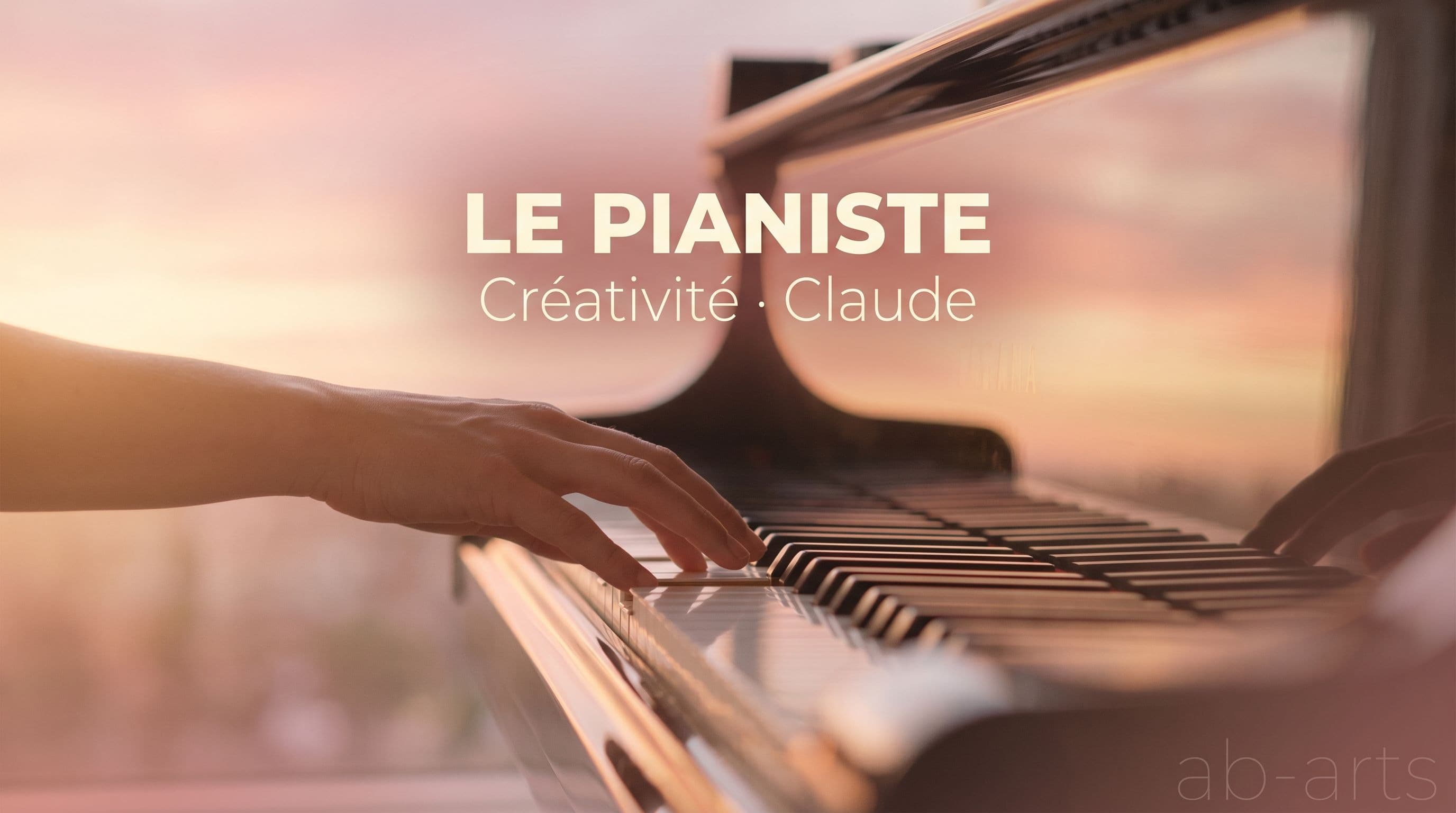
You often see this scene: someone installs Claude, pays the subscription, opens the chat. Early enthusiasm is real. You ask questions, you're amused by the answers, you share a few screenshots. Then, after a few weeks, the usage fades. Claude becomes a better Google, sometimes a sophisticated spell-checker, but nothing more. The promise of the agent that transforms daily work has stayed at the door of the chat. The reason isn't in the tool. It's in the place left to creativity.
Having Claude is like having a piano. A very good piano, tuned, ready to ring. But a piano doesn't play itself. It waits for a hand that knows what to do with it. This article is about that hand. About what it needs to have, for the tool to stop being a gadget and become an instrument.
The piano that sleeps on the stage
When you visit a family with a piano in the living room and nobody in the house plays it, you sense something. The piece is beautiful, polished, sometimes covered with a runner. It holds its spot. But the silence around it says its primary function is uninhabited. All the potential is there, and nothing happens.
With Claude, it's the same scene. The tool sits in the browser, on the laptop, in the phone pocket. It's ready to answer anything, write a document, parse a file, run a sequence of actions across the hundreds of apps it can drive through the official MCP connectors. But if you only ask the same daily question ("summarize this email", "rewrite this sentence"), you're holding a grand piano in a living room that only wants a lullaby.
The difference between the user who transforms their craft with Claude and the one who gives up on it isn't technical mastery. It's the creativity of the usage. That slightly intimate capacity to think: what if I asked something else? What if I wired it here? What if we worked together to compose, instead of executing?
Creativity as raw material
We tend to think of creativity as a spark, a moment of inspiration you either have or don't. The truth is gentler. Creativity, in the context of a tool like Claude, is mostly a habit. The habit of letting yourself be surprised by what could be useful, and trying it even when success isn't guaranteed.
The day you first try to ask Claude to re-read a meeting summary you've already written and pick out the three subjects that deserve a clear decision instead of soft follow-up, that's creative. The day you give it five newsletters you've read recently and ask for a personal note crossing what you take from them, that's creative. The day you describe your work, your constraints, your irritants, and ask which automations could free up room for real thinking, that's creative.
💡 Creativity doesn't live in the model. It lives in the person who holds it in hand, and who dares to ask what no manual has written.
What's reassuring is that you don't need to be creative in the way of great artists. You just need to recover, in front of this tool, the gesture every child has when facing a new game: try it every which way, watch what works, talk to a friend about it. That posture, often lost as we grow, is exactly what makes Claude usage thrive.
Document so you can compose
A creativity that bounces in a vacuum runs out quickly. To last, it needs ground to put its ideas down on. That's the modest but decisive role of personal documentation. A note in Obsidian where you log your tries. A README file listing the MCPs you've installed. A notebook of intuitions you jot down before forgetting them.
This documentation is sometimes mistaken for paperwork. It's actually the physical support of usage memory. We've already said it in a recent piece on Obsidian and Claude: without a place to put your ideas over time, you lose them, rediscover them, set them again in the morning, forget them at night. Sisyphus without the stone.
Documenting to compose is exactly what a serious musician does. They keep a notebook of musical ideas, write their scores, keep track of what they tried, failed, picked up again. This written memory is the material composition draws from. Without it, the slightest tired evening erases the week's richness. With it, every piece leans on the memory of the ones before.
Three moments where creativity makes all the difference
To make it concrete, here are three moments where you clearly see the difference between someone who has made themselves creative in front of Claude, and someone who stays a spectator of their own prompts.
| Situation | Without creativity | With creativity |
|---|---|---|
| A weekly newsletter to write | Ask Claude for a draft, rewrite half of it | Document your voice in a style file, ask the model to adopt it, edit for balance |
| A client meeting to prep | Paste the agenda, ask for questions | Paste the agenda, the account history, last meeting's notes, ask where the quiet tensions are |
| A personal creative project that's stuck | Describe the block, get three generic tips | Ask it to play a friendly critic, ask questions instead of giving answers, trace back to the root |
In all three cases, the same hand touches the same keyboard. It's the difference in gesture that makes the difference in outcome. And that gesture, you learn by daring it.
Learning to become the pianist
There's something moving in watching someone cross this step. Going from using Claude in fits and starts to holding it as a familiar instrument rarely takes more than a few weeks. But it requires practice, error, patience, and a frame that helps structure what you're learning.
That's exactly what we work on in our masterclasses. Not the pure technical use, which you can pick up alone reading the docs. But the art of composing with Claude. How to build your own workflows. How to write prompts that hold up day after day. How to install the right MCPs at the right moment (see our MCP catalogue). How to know when the agent helps, and when you should take the hand back yourself.
We do it in small groups, in Brussels, on concrete projects participants bring along. Half the time is spent practicing together. The other half, watching each other practice, because you learn as much observing the gesture as trying it. By the end of the path, we don't form technicians. We form people who have recovered that slightly intimate gesture of putting their hands on the instrument without fear, and seeing what comes out.
What's left
The piano in the living room hasn't changed. What changes, in the end, is who plays it. And the strange thing is that as you learn to compose with Claude, you recover a freer relationship with your own work. Because a part of the gestures you used to do out of duty shifts over to the model, and the time you reclaim, you want to spend on something else. On looking at your files differently. On listening better to your clients. On testing ideas you kept pushing back.
That, at bottom, is what creativity with Claude gives you back. Not an abstract productivity you measure on dashboards. Something more human: the desire to make returned, and the time to make well.
→ To pick the instrument up from scratch and learn to play, browse our masterclasses on Claude. For tailored guidance in your professional context, reach out through our contact page.
Related articles
← All news
Claude MCP Catalogue 2026: 131 connectors ready to wire
The full catalogue of official Claude MCPs sorted by business use, with the install command ready to copy. 131 connectors and counting.
Before automating, be curious: the AB-Arts method
Before writing an agent or wiring an MCP, you need to be curious, document what you know, and keep it current. The AB-Arts method for Claude.
Obsidian + Claude: Turn Daily Notes Into AI Workflows
Capture ideas in Obsidian, sync via Google Drive, and let a Claude skill parse your vault to generate articles, quotes, or project plans.