
Campus AI: France Scales Sovereign AI Up to 3 GW
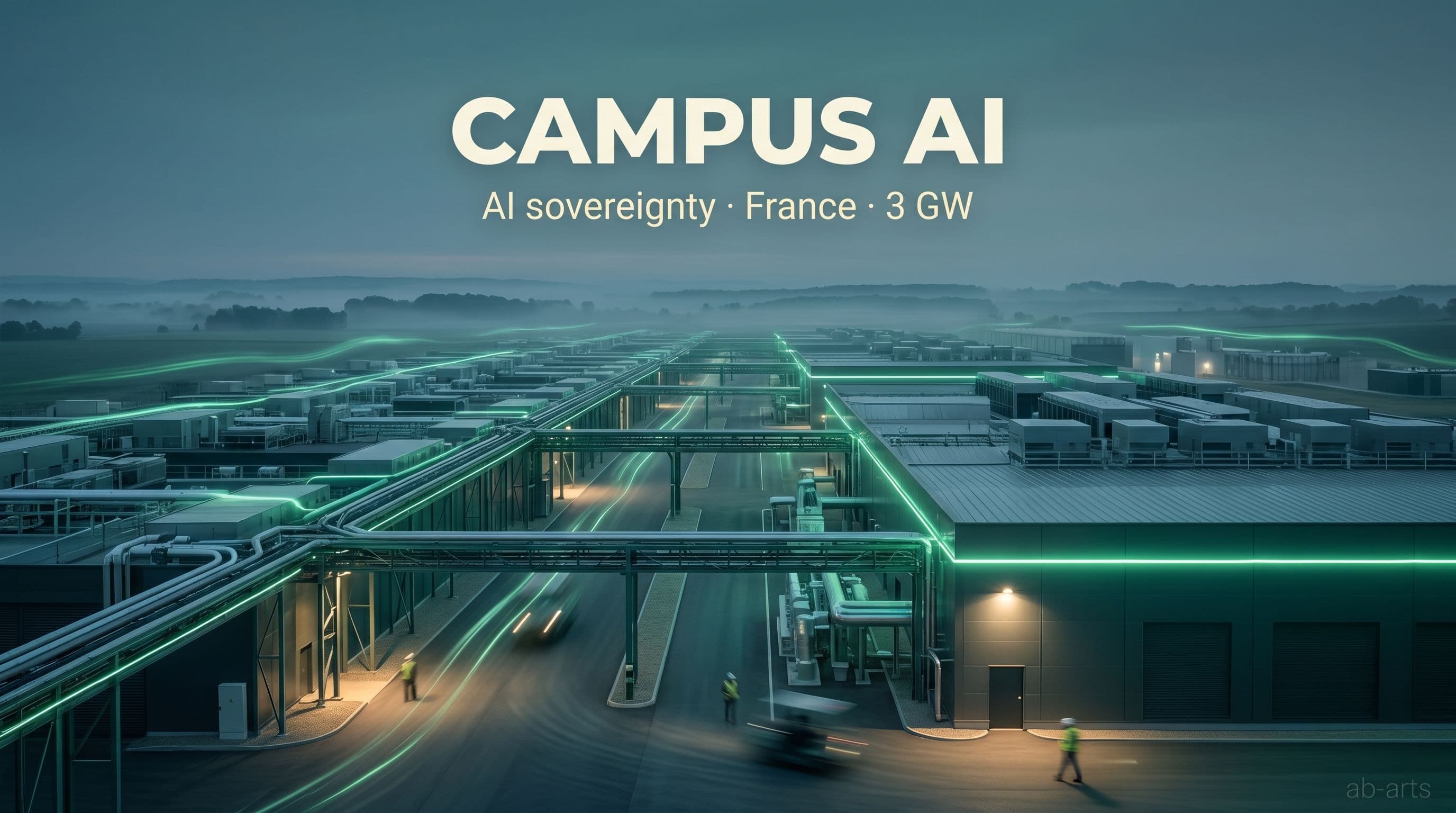
At the 2026 Choose France summit, the announcement came in a single line: Campus AI, the artificial intelligence factory project planted in Fouju, Seine-et-Marne, now targets 3 gigawatts of compute, supported by a global investment of 7.5 billion euros. Behind the figure, an implicit question travels across Europe: are we watching a genuine industrial turning point, or the shadow theater of a sovereignty in name only?
Before this announcement, Europe talked a great deal about sovereign cloud and invested very little. Now, a concrete project brings together Mistral AI, Bpifrance, the Emirati fund MGX and NVIDIA around an infrastructure whose sheer electrical footprint forces the question to be reframed. From Brussels, where we create daily with AI, the event deserves more than reflexive enthusiasm or knee-jerk criticism. It deserves to be read for what it actually changes, and for what it does not.
Digital sovereignty is not a flag planted on a data center. It is a chain of dependencies, and Campus AI shifts some links without breaking others.
What 3 Gigawatts Concretely Mean
The figure flies by in press releases, but it deserves a pause. One gigawatt equals the electrical output of a mid-generation nuclear reactor, or the instantaneous consumption of roughly one million French households. At 3 GW, Campus AI ultimately aligns with the output of nearly three nuclear reactors. That equates to the residential electricity demand of three million households, mobilized continuously to keep servers running.
For context, a typical hyperscale data center today operates between 50 and 200 megawatts. The French project aims for fifteen to sixty times that scale, concentrated across a handful of sites. The first one, already under construction in Fouju, will be followed by a second location yet to be confirmed. At this scale, we are no longer talking about a building, but about an industrial district dedicated to compute.
In practice, this power will serve to train and run ever larger foundation models. NVIDIA, technical partner on the project, will supply the chips and the compute architecture. Actual energy consumption will depend on utilization rates, but the announced envelope sets the ambitious ceiling the French ecosystem is targeting for the next five years.
The Quartet: Mistral, Bpifrance, MGX and NVIDIA
The joint venture rests on a four-actor team, each contributing a different piece. Mistral AI, the French unicorn founded in Paris in 2023, brings model expertise and will get priority access to compute for training future generations. Bpifrance, the public investment arm, provides French state backing and significant capital. MGX, the specialized sovereign fund of the United Arab Emirates, supplies the bulk financing that makes the 7.5 billion global envelope achievable. NVIDIA, finally, is the technology partner: without its chips, no AI campus is possible today.
| Actor | Origin | Contribution to the project |
|---|---|---|
| Mistral AI | France | Models and priority access to compute |
| Bpifrance | France (public) | Capital and state backing |
| MGX | United Arab Emirates | Bulk financing |
| NVIDIA | United States | Chips and compute architecture |
This composition tells a story the official communication tends to soft-pedal: sovereignty here is shared by construction. Bpifrance's official press release presents the joint venture as the largest in Europe, which is factually accurate, but does not detail the fine breakdown of financial stakes. Emirati capital weighs heavily in the equation, and that very presence is what makes the project economically viable at this scale.
The French Energy Bet
The project's structural asset, and where France genuinely distinguishes itself from its European neighbors, lies in its electricity mix. The country produces about 70 percent of its electricity from nuclear, complemented by hydro and a growing renewable fleet. The result is one of the most decarbonized kilowatt-hours on the continent: around 50 grams of CO2 per kWh, against 350 in Germany and over 700 in Poland.
For an infrastructure that will consume as much as a large city, that gap is decisive. Training a foundation model in France emits, at equivalent power, six to ten times less carbon than in Poland, and roughly seven times less than in coal-heavy US states. Alliancy emphasizes this very point in its recent analysis of the project: the environmental argument becomes, for France, an industrial argument.
That said, the bet is not without tensions. Mobilizing an additional 3 GW on the Paris-region grid requires trade-offs with domestic use, industry and electric mobility. Whether the existing nuclear fleet and future EPR2 reactors can keep pace remains an open question. The technical debate is legitimate, and the government has yet to settle the precise supply arrangements.
Sovereignty Heads, Sovereignty Tails
To honestly assess what Campus AI changes for European digital sovereignty, the notion has to be broken down. Sovereignty is not a binary state but a bundle of dimensions, some of which are genuinely strengthened by the project, others left open or even weakened.
| Dimension | Heads (strengthened) | Tails (limit) |
|---|---|---|
| Jurisdiction | Servers on French soil, European law applies | US Patriot Act potentially reaching NVIDIA |
| Financing | Bpifrance involved, French public capital | MGX brings the bulk, Gulf dependency |
| Hardware | Operational and deployment control | US NVIDIA chips, no credible alternative |
| Energy | Decarbonized nuclear mix, controlled price | Pressure on Paris-region grid, public trade-offs |
| Models | Priority access for Mistral, French ecosystem | Mistral remains one actor, not a near-monopoly |
That table says the essential: Campus AI shifts certain links in the dependency chain without breaking others. Jurisdiction over the physical servers moves into French and European law, which matters for a Belgian studio mindful of how its data is handled. On the other hand, the chips that power those servers still come from a single US supplier in a near-monopoly position, and financial sovereignty is diluted by the Emirati share.
The Real Limits
Three factors deserve to be named plainly, because they will surface in the public debate of the coming months and because a professional studio cannot just defer to official communication.
First, hardware dependency. The NVIDIA H200 and Blackwell GPUs that will most likely equip the campus are manufactured only in Taiwan and designed in the United States. Any US export restriction, from one administration or the next, would instantly redraw the project's capabilities. On top of that, competing European chips (SiPearl, a revived Graphcore) remain several years behind on raw performance.
Next, farmland artificialization. The Fouju site and the upcoming second one mobilize several dozen hectares in peri-urban zones around Paris. Local associations and chambers of agriculture have voiced concern, and regional press has relayed the first objections. The project is not territorially neutral.
Finally, energy strain. RTE, the French transmission grid operator, will need to confirm that the Paris region can absorb 3 additional gigawatts without destabilizing domestic and industrial supply. The debate is technical but also political: we are talking about power trade-offs across very different uses.
From Brussels, What Changes for a Creative Studio?
In the short term, little, and we should say so honestly. A Belgian studio creating with AI today, whether for image, video or audio generation, still relies on models hosted mostly in the United States or via multi-cloud APIs. Campus AI will not be operating at full capacity before 2027 or 2028, and priority access is reserved for Mistral and its direct partners.
In the medium term, however, several things shift. Mistral, boosted by this access to compute, should ship larger and faster foundation models, broadening the choice beyond US-only actors. Inference costs, meaning the price to run an already-trained model, should decrease for European users. Data jurisdiction, especially for sensitive client projects, gains clarity when the physical infrastructure sits in Europe.
This is exactly the kind of transition we track closely at AB-Arts. Understanding the ecosystem, knowing where each actor fits in, anticipating the shifts: that is what separates a studio that endures AI from one that steers it. Our Academy is designed for that very reading: decoding announcements, gauging their real reach, adjusting practices. For studios that want an AI strategy aligned with their own stakes, our AI audits start precisely from these questions of sovereignty, cost and dependency.
This episode fits into a longer sequence we have been documenting for months. After DeepSeek's emergence cracked the hegemony of closed models, and NVIDIA's quantum turn redefined the hardware horizon, Campus AI completes the picture on the infrastructure side. Three pieces of the same geopolitical puzzle, with the design sharpening.
For a Belgian studio building in this shifting landscape, the question is not which camp to pick. It is to understand where each tool draws its dependencies, and to align its own practice accordingly. We support that reflection case by case, with the nuanced read such a complex subject deserves.
Move from reading to producing.
What we experiment with here, we ship for you. AB-Arts designs, trains and supports: three ways of working together, one team under the same roof.
Web, motion, video, image and campaigns. From concept to master, full production under one roof.
AB-Academy trains your teams in AI, workflows and creative tools. On-site or remote.
Audit, consulting, automation. We clear up your digital environment, and build what's missing.
Related articles
← All news
AB-Arts is a Google Partner: Cloud, Vertex AI, Workspace
AB-Arts is a Google Partner. We deploy Google Cloud, Vertex AI and Workspace for European teams: security, compliance and hands-on support.
Claude MCP Catalogue 2026: 131 connectors ready to wire
The full catalogue of official Claude MCPs sorted by business use, with the install command ready to copy. 131 connectors and counting.

Before automating, be curious: the AB-Arts method
Before writing an agent or wiring an MCP, you need to be curious, document what you know, and keep it current. The AB-Arts method for Claude.