
NVIDIA RTX Spark: personal AI moves into our laptops
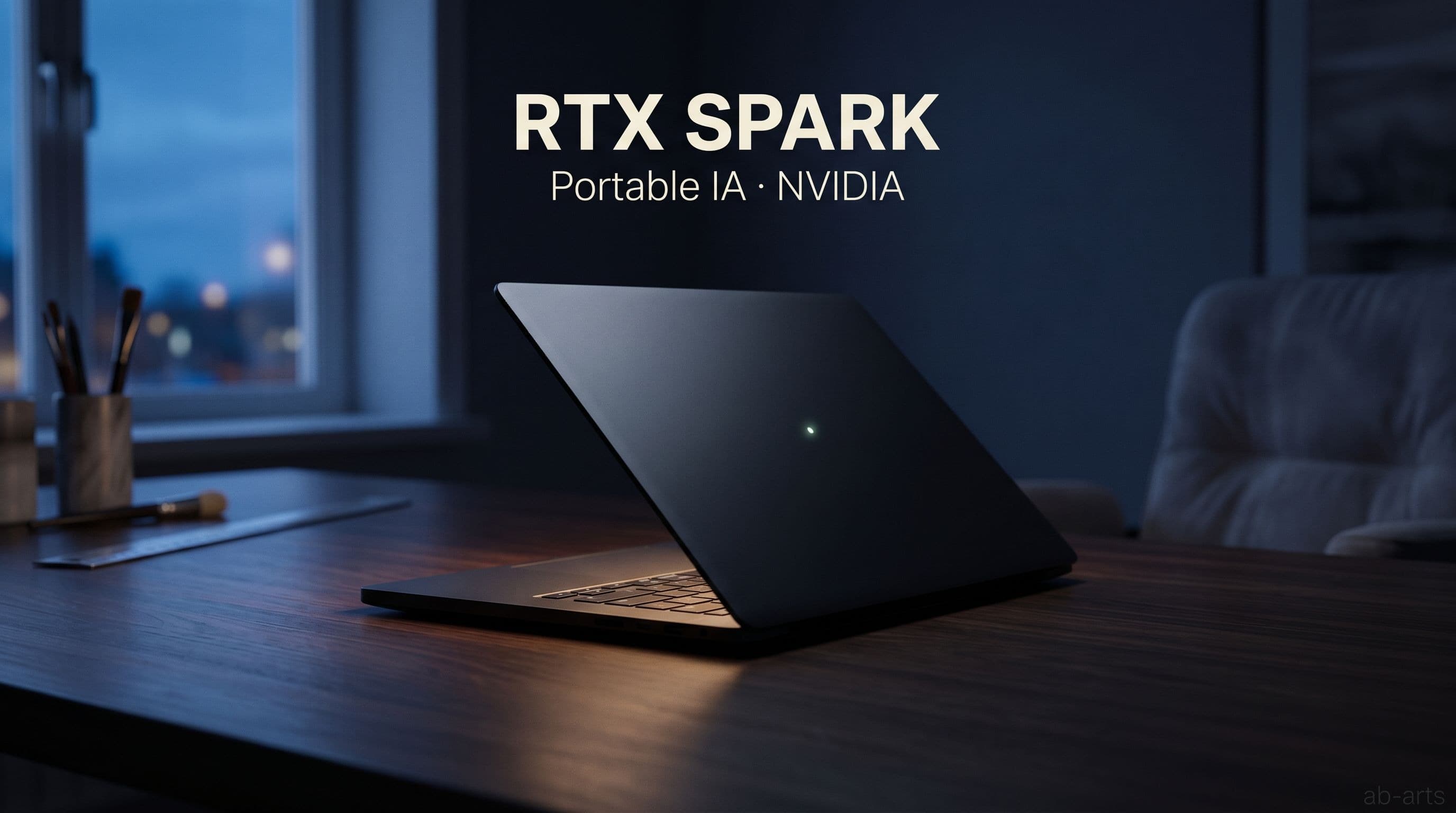
NVIDIA RTX Spark is NVIDIA's new portable AI platform: a chip dedicated to AI inference, and reference laptops that ship with it. In one sentence: it's the first time a mainstream laptop is engineered, all the way down to the silicon, to run generative AI models locally — no cloud required.
Until now, when you asked Claude, ChatGPT or Gemini a question from a laptop, that question traveled miles of fiber to reach a data center, was processed on tens of thousands of euros of shared hardware, and came back. The laptop, however capable, was little more than a luxury terminal. RTX Spark flips that geography. And what it announces is not just a new piece of hardware — it's the start of a deeper shift, one that questions what we expect from a machine, and even more, what our own reason becomes in front of it.
What RTX Spark actually is
RTX Spark comes in two inseparable layers. At the heart, a chip NVIDIA designed for the new generation of AI laptops: it combines a latest-gen RTX GPU, Tensor cores tuned for on-device inference, and memory sized to host large language models right on the machine. Around it, reference laptops that frame the chip in a chassis, thermal design and battery life built for mobility.
The official NVIDIA page spells out the precise specs: inference performance, memory capacity, supported models, OEM partners. For this article, what matters is not any single number but the fact that this kind of capability now fits in a portable form factor, battery-powered, carried in a backpack.
On the software side, NVIDIA ships its full familiar stack: Studio drivers tuned for creators, local inference runtimes, integration with the main frameworks like PyTorch, TensorRT and llama.cpp. In short, you open the laptop, install an open-weight model, and inference runs immediately on the hardware — no API key, no connection, no subscription.
The laptop stops being a terminal
The change reveals itself as you unfold the consequences. Today, every AI model call from a laptop comes with a per-token cost, variable latency, and a round trip of your data to servers whose precise location you don't know. On the road, it's worse — network quality dictates answer quality, and the slightest dropout leaves your assistant mute.
With an RTX Spark laptop in your bag, compute travels with you. The model runs on the machine. Your data never leaves the drive. The marginal cost of a call drops to the battery energy it draws. And for open-weight models freely distributed on platforms like Hugging Face, there's no subscription, no quota, no queue, no outage.
For advanced users, the payoff goes further. Where the cloud dictates which models you use and on what schedule, local lets you experiment freely: test a new model the day it drops, fine-tune it on your own data, compare several variants side by side, with no API budget anxiety and no need to be tethered to a data center. It's a return to the researcher's stance, in a field that had started to feel like SaaS user-land.
The laptop as an everyday autonomous agent
RTX Spark isn't just a more powerful work tool. It makes tangible a quieter shift: your laptop stops being a window onto distant services and becomes a work companion that permanently hosts a model of tens of billions of parameters. That presence changes everything.
What happens when an AI agent runs in the background on the machine you carry everywhere? It observes your rhythm, anticipates your meetings, sorts your inbox, prepares your files, drafts your next document before you've even asked. The machine stops being a tool you pick up — it gets closer to a quiet, persistent companion that learns from your habits precisely because its computation never leaves your drive.
It's exactly the kind of agent Google shipped a first version of with Gemini Spark, or Anthropic with its Claude Skills. Tomorrow's difference, with an RTX Spark laptop, is that these agents will run at your place, not at theirs. Which carries its own implications: full intimacy with your data, independence from any single vendor, but also increased responsibility for what you let the agent do on your behalf.
What human reason becomes
Here is where you have to pause for a moment, because this descent of AI into our personal laptops opens a philosophical question that we're wrong to keep deferring. If the machine can now generate text, compare sources, plan a sequence of actions, and execute multi-step tasks on its own, what exactly is left that is properly human?
💡 AI doesn't replace human reason. It displaces it — from doing to judging.
The answer isn't in raw calculation. A ten-euro pocket calculator already outruns any mathematician at pure arithmetic, and nobody has concluded from that that mathematical thinking is over. The answer isn't in factual memory either, long since outsourced to search engines. And it isn't in synthesis, which models now produce by the truckload.
What remains — and grows more demanding as the machine takes on more — is the work of judgment. Knowing how to frame the right question. Telling apart what's worth processing from what isn't. Verifying what the agent brings back. Deciding when its answer is correct, when it's plausible but wrong, when it's right but missing the actual point. The very instant the machine becomes able to execute, the human has to become sharper about what they want.
What's more — and this is where the ethical dimension enters — an autonomous agent running on your laptop acts in your name, wherever you carry it. What it does, you sign. The skill to acquire is no longer just technical: it's that of a manager directing a team of agents, knowing what to delegate and what not to, vetting the deliverables before approving them. Human reason, from here on, is less the faculty that computes — it's the one that decides, that verifies, that owns the outcome.
Train yourself: the dividing line that's forming
From this new geography of intelligence, a dividing line is emerging, and it's worth naming clearly. In two years, everyone will have access to powerful models — in the cloud, on a local RTX Spark-class laptop, or directly inside their phone. The question will no longer be: who has AI? It will be: who knows how to use it as a partner they direct, rather than a tool they push buttons on?
That skill doesn't come for free. It's learned, as you build your own flows, chain several agents together, test their answers against the friction of the real world. It's exactly what we work on in our masterclasses — not the bare technique of AI, but the craft of directing it inside specific professional contexts.
| If you want | Masterclass | What you build |
|---|---|---|
| To master Claude as a real working partner | Masterclass Claude | Skills, projects, and Claude agents wired into your workflows |
| To build Google agents and cloud pipelines | Google AI Studio & Cloud | Gemini flows, Spark agents, Google Cloud integration |
| To compose AI-assisted visual productions | AI image & video tools | AI-generated image, video, sound — full pipeline |
Worth noting: AB-Arts is a Google Partner, which means we work on early-access pieces of Google's AI ecosystem, and we know which uses hold up in production versus which stay conference demos. That distinction — practical, not theoretical — is the other shape human reason takes when applied to AI: knowing what actually works, and teaching it.
RTX Spark is just a laptop. The real question is what you'll do with it
The object itself, open on a desk or slipped into a bag, is only a stage. What matters is the trajectory it makes visible: AI is moving in for good — into our laptops, our phones, our daily professional life. The time this shift frees up, each of us will spend as we choose. Either pushing buttons a little faster. Or moving up a step, directing agents, composing flows, taking the orchestrator's seat that machines, by construction, cannot occupy.
→ To experience today what AI models combined inside a single pipeline feel like, open ab-arts.studio. To acquire the full, durable discipline, browse our masterclasses.
Related articles
← All news
Google Drive Projects: Gemini orchestrates your folders
Google Drive Projects bundles folders, mail and tasks into one Gemini-powered workspace. Our Google AI Studio & Cloud masterclass covers it.
OpenAI Codex vs Claude: a duel of AI coding agents
OpenAI revives Codex, its dedicated coding agent. We compare it to Claude Code, the tool we teach in our Claude masterclass. What changes in practice.
Gemini Spark: Google's agent that takes action
Google releases Spark, an AI agent that runs complex tasks autonomously. We cover it in our Google AI Studio masterclass. Here's what to know.